
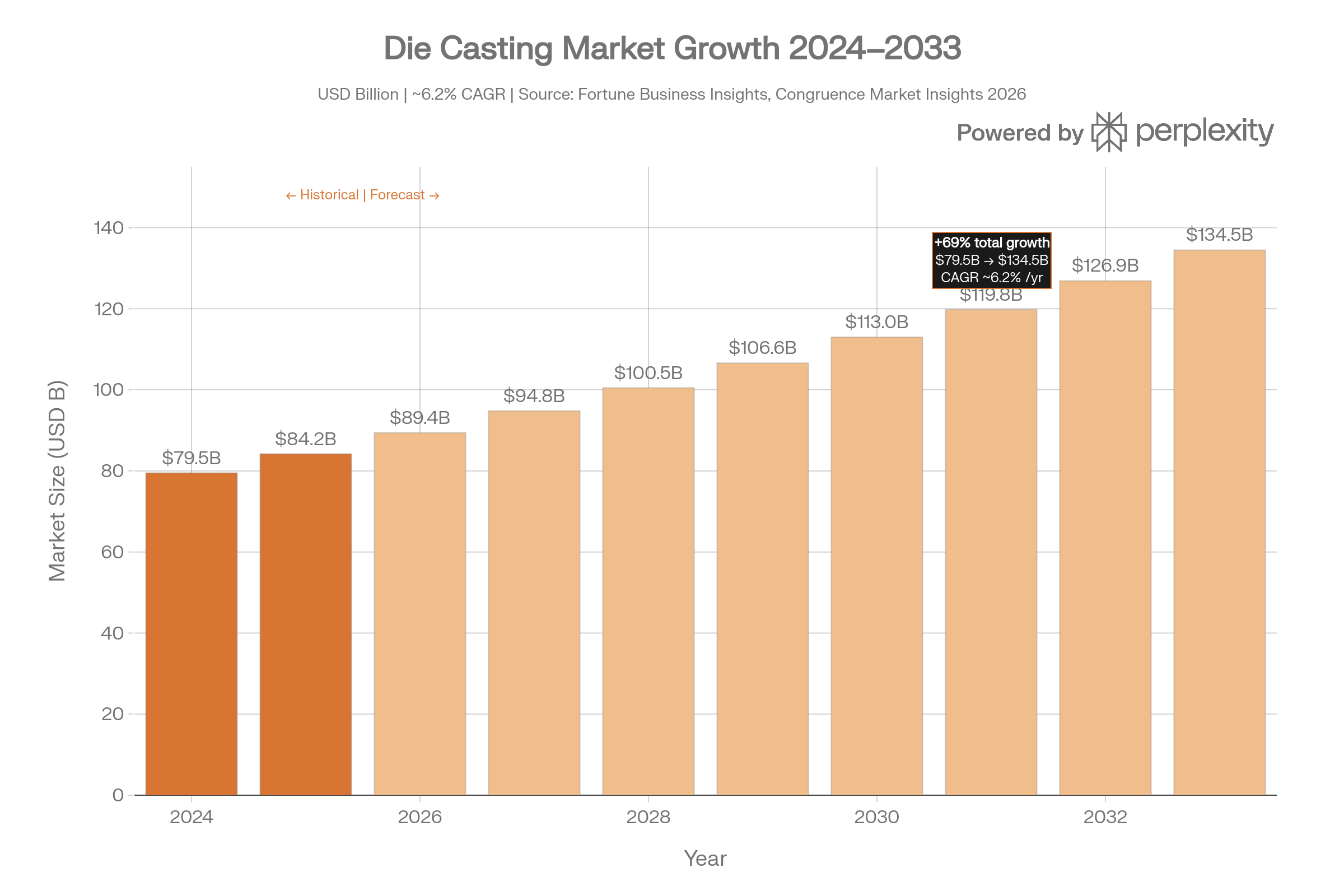
The global aluminum die casting market is projected to grow from approximately $86.5 billion in 2025 to nearly $98 billion by 2031 — a compound annual growth rate of around 6.2% that sounds straightforwardly positive.
Global demand for aluminum die cast products is expected to increase by 50% by 2034.
The International Aluminium Institute, market research firms, and automotive industry analysts all point in the same direction: more aluminum, more die casting, more demand.
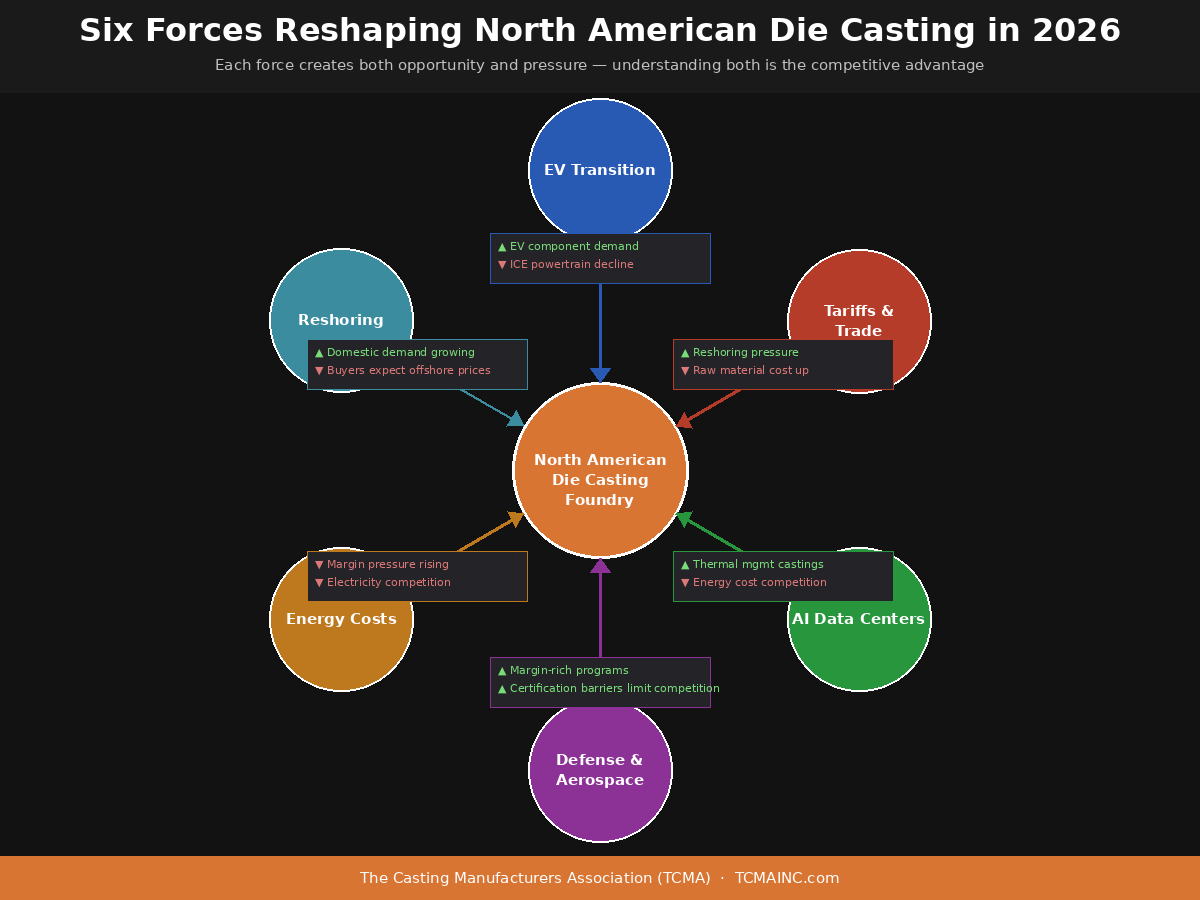
But for a foundry owner in Ohio, Michigan, Wisconsin, or Pennsylvania, the aggregate numbers don't tell the full story. The die casting market in 2026 is not uniformly growing — it is bifurcating. Some segments are expanding aggressively. Others are under margin pressure they haven't faced before. New demand is emerging from directions nobody anticipated five years ago. And the macro forces reshaping the market — EV adoption, trade tariffs, AI infrastructure build-out, defense spending, and energy costs — interact with each other in ways that create winners and losers within the same industry.
This post breaks down each of those forces in plain language, with practical implications for North American die casting foundries at every stage of that transition.
Before examining individual forces, it helps to understand the current market structure.
Within that growth, the application breakdown matters enormously for North American foundries:
That capacity expansion is happening — but it's concentrated among suppliers with the scale and capital to invest.
The electric vehicle transition is the most discussed force in the die casting industry, and for good reason.
Global EV production exceeded 14 million units in 2024, representing a 35% year-over-year increase.
By those numbers, EV growth is unambiguously good for die casting.
But the EV story for foundries has two very different chapters depending on what you make and how large you are.
Tesla pioneered the approach; Volvo, Toyota, and others have followed.
This is a segment that rewards foundries with significant capital, close OEM relationships, and the floor space to accommodate machines that are, quite literally, the size of a house.
For most regional North American die casting foundries, giga-casting is not a near-term opportunity. It requires capital investment that rivals the total enterprise value of many independent foundries.
The more accessible EV opportunity lies in the components that don't require giga-casting investment:
These components are well within the process range of mid-size regional foundries. They require tight dimensional tolerances, pressure-tight integrity, and increasingly, alloys with specific thermal conductivity properties — all achievable with existing high-pressure die casting equipment.
Practical implication: The threat from EV transition for die casters is concentrated in traditional powertrain components — transmission housings, engine blocks, oil pans — that are declining with ICE production. The opportunity is in thermal management, structural battery components, and e-mobility hardware. Foundries currently dependent on ICE powertrain work should be actively developing capability in EV thermal management applications.
The new standard requires that aluminum be "smelted and cast" within the qualifying region to meet domestic sourcing requirements, effectively closing loopholes that had allowed offshore-processed aluminum to enter the U.S. supply chain with minimal duties.
The intent is straightforward: rebuild domestic aluminum capacity, reduce reliance on foreign imports, and strengthen supply chain resilience for defense and industrial applications.
For North American die casting foundries, the tariff picture creates genuine opportunity — and genuine cost pressure simultaneously.
The combination of tariff costs, supply chain disruption risk (still vivid from the COVID years), and increasing OEM preference for domestic traceability is making offshore die casting less economically attractive for a meaningful segment of buyers.
The foundries winning reshoring business share a common profile: they hold relevant certifications (IATF 16949 for automotive, AS9100 for aerospace), they can demonstrate quality traceability, and they can articulate a compelling total landed cost story — not just piece price, but the full cost including tariffs, freight, lead time risk, and quality failure exposure that offshore sourcing carries.
For a foundry purchasing hundreds of thousands of pounds of aluminum annually, that tariff increase flows directly into material cost.
The practical reality: reshoring-driven demand increase and raw material cost increase are happening simultaneously. Foundries that can pass tariff-driven material cost increases through to customers via contract alloy adjustment clauses will be better positioned than those locked into fixed-price agreements. For new reshoring business, price-setting conversations should explicitly address alloy cost exposure.
Practical implication: Reshoring is a real, near-term demand driver — not just a political talking point. But it flows to foundries that are certified, visible, and able to have sophisticated total landed cost conversations with buyers. Foundries presenting only piece price in a reshoring pitch are leaving the most compelling arguments on the table.
If you had asked a die casting industry analyst in 2021 which non-automotive segment would emerge as a significant driver of aluminum casting demand by 2026, almost none would have said artificial intelligence infrastructure. Yet here we are.
Aluminum is a critical material in data center cooling systems, server racks, heat sinks, GPU enclosures, and structural components.
For die casting foundries producing precision aluminum components for cooling systems, enclosures, and structural hardware, this represents a new and growing customer base that did not exist meaningfully five years ago.
This competition is tightening power availability and raising rates in precisely the states where North American die casting foundries are concentrated.
For a foundry operating multiple induction furnaces and high-pressure die casting machines, energy is already the second or third largest operating cost. A 20–30% increase in electricity rates is a margin event, not a rounding error.
Practical implication: Data centers represent a genuine new revenue opportunity for foundries producing precision aluminum thermal management components. At the same time, foundries located in data center construction corridors should be actively modeling their energy cost exposure and evaluating long-term power contracts, on-site renewable generation, and equipment efficiency upgrades before electricity rates move further against them.
Defense spending increases under the current administration, combined with a multi-year aerospace production ramp (including Boeing's recovery from its quality issues and a sustained backlog in commercial aviation), are driving demand for precision die castings in both sectors.
Defense programs — from next-generation fighter programs to ground vehicle modernization to naval shipbuilding — require aluminum and specialty alloy castings in quantities that dwarf commercial aerospace volumes.
The margin profile of defense and aerospace casting work is fundamentally different from automotive. Where automotive die casting margins are compressed by OEM cost-down pressure, competitive bidding, and commodity pricing dynamics, defense and aerospace work carries:
Those qualification barriers are the critical point. AS9100 certification, Nadcap approval for specific special processes (heat treatment, NDT), ITAR registration, and sometimes customer-specific qualification requirements (Honeywell Approved Supplier, Boeing D1-4426) are the entry tickets to aerospace and defense casting work. Foundries that have invested in these certifications are effectively in a smaller competitive pool for a higher-margin customer base.
Practical implication: Defense and aerospace represent the best near-term margin opportunity in North American die casting — but only for foundries that have done the certification work. If your foundry is IATF 16949 certified but not AS9100 certified, a gap analysis comparing the certification cost against the accessible market opportunity may reveal a compelling investment case.
Energy costs deserve more attention than they typically receive in industry outlook discussions, because they are the most controllable major cost variable most foundry operators are underinvesting in managing.
For aluminum die casting specifically, the combination of induction melting, high-pressure machine operation, heat treatment, and facility HVAC creates significant energy demand concentrated in peak rate periods.
The 2026 energy cost environment for North American foundries is worsening for structural reasons that are not expected to reverse:
What leading foundries are doing differently:
Equipment efficiency:
The capital cost is significant, but the payback period at current energy rates is measurable in years, not decades.
Operational scheduling: Shifting high-energy operations (melting, heat treatment) to off-peak rate periods reduces energy cost without capital investment. Surprisingly few foundries have implemented formal energy scheduling programs.
Federal grant programs:
Most North American foundries are not capturing available grant funding, either because they're unaware of the programs or lack the administrative bandwidth to apply.
On-site generation:
The economics have improved significantly as electricity rates have risen.
Practical implication: Energy strategy is no longer a facilities management topic — it is a competitive differentiator. A foundry that locks in energy costs below the market rate through efficiency investment, scheduling, and on-site generation gains a durable cost advantage over competitors that don't. In an environment where piece price competition is intense, a 3–5 point energy cost advantage flows directly to margin.
The reshoring narrative has been a fixture of North American manufacturing commentary for years. In 2026, it is more real than it has been at any previous point — but it comes with important caveats.
The genuine reshoring demand is concentrated in specific verticals:
They know what the Chinese or Mexican foundry was charging. They want domestic sourcing without paying the full domestic price premium.
Foundries that win reshoring business consistently are those that reframe the conversation around total landed cost — the full cost of ownership including tariffs (now 25% on aluminum articles), ocean freight, duty drawback complexity, lead time carrying cost, quality failure risk, and the commercial and reputational cost of a supply chain disruption. When those factors are quantified explicitly, the domestic premium often disappears or inverts.
Practical implication: Reshoring is an opportunity — but winning it requires a different sales conversation than domestic replacement business. Build a total landed cost comparison tool. Quantify the risks of offshore sourcing for your target customer's specific situation. Make the case in their language, not yours.
The six forces above are reshaping which buyers are in the market, what they're looking for, and how they're finding it. That has direct implications for how a die casting foundry should be positioning and marketing itself in 2026.
EV thermal management buyers are searching specifically — "aluminum die casting thermal management," "battery enclosure casting supplier," "EV motor housing die casting." If your foundry serves this market and your website doesn't use this language, you are invisible to a buyer who is actively looking.
Reshoring buyers are searching with geographic and certification intent — "IATF 16949 aluminum die casting Ohio," "domestic die casting foundry automotive," "ISO certified die casting Michigan." A buyer reshoring from Mexico or China is specifically looking for a certified domestic supplier. Certification visibility on your website and in directory listings is the first filter.
Defense and aerospace buyers search within qualified supplier databases and are increasingly using AI search tools to identify potential sources. Being cited in credible industry sources — trade association directories, technical publications, educational content — increases your probability of appearing in AI-generated supplier recommendations.
Data center component buyers are newer to sourcing aluminum die castings and may not know which foundry characteristics to look for. Content that educates this buyer — explaining die casting capabilities for thermal management applications, tolerance ranges, alloy options for thermal conductivity — positions a foundry as a knowledgeable partner before the first RFQ arrives.
This is precisely where TCMA membership creates a compounding advantage. An SEO-optimized member profile with accurate process, alloy, certification, and industry tags — combined with TCMA's educational content that buyers reference during their research — puts TCMA member foundries in front of the buyers that the forces above are driving into the market right now.
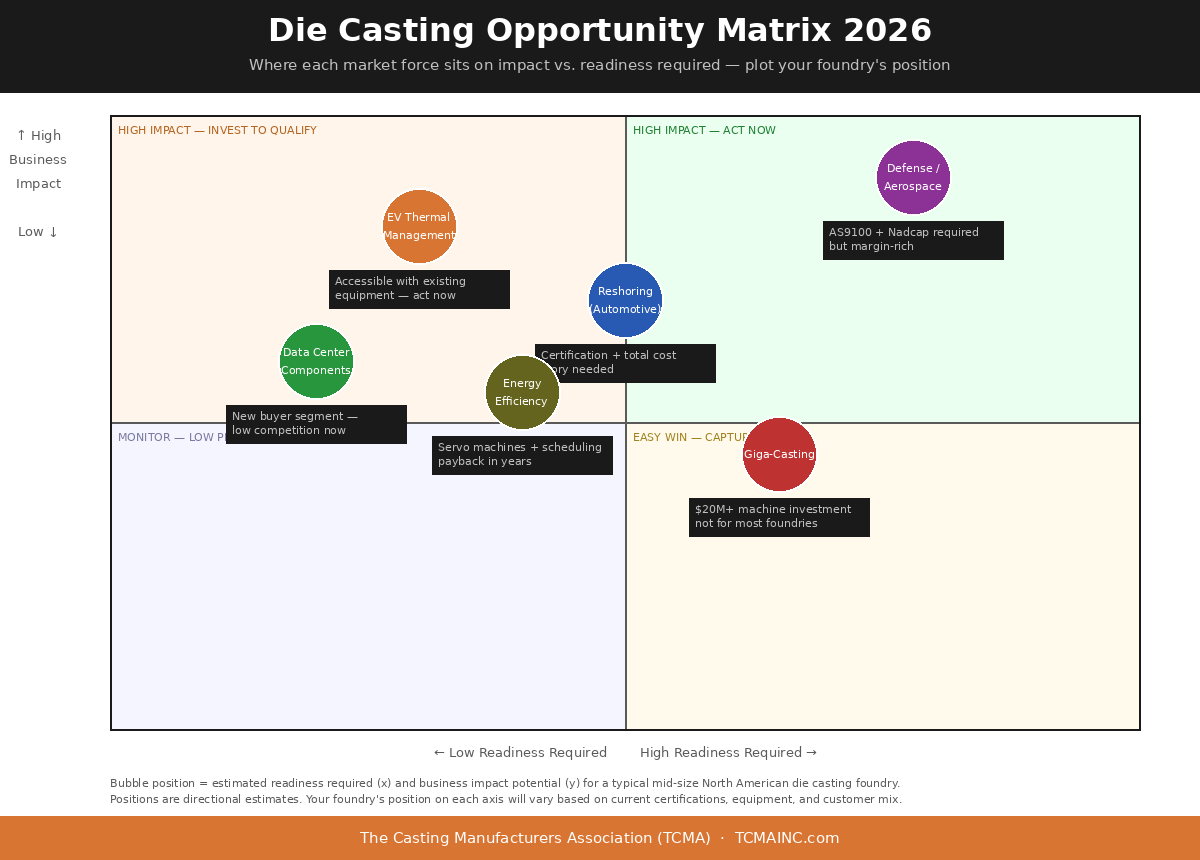
Work through these honestly. The answers will tell you where your most urgent priorities are.
1. Which side of the EV transition are you on?
Are your current automotive programs primarily ICE powertrain components? If so, what is the realistic timeline for volume decline, and have you mapped the EV component opportunities your existing equipment can serve?
2. Are you capturing reshoring inquiries — or missing them?
When a buyer searching for a domestic die casting supplier for a reshored program searches Google today, do you appear? A practical test: search your primary process + your state. If you're not on page one, you're not in that buyer's consideration set.
3. Is your certification profile aligned with your target markets?
IATF 16949 for automotive, AS9100 for aerospace/defense, ISO 9001 as a baseline — are your certifications current, correctly scoped, and prominently visible to buyers? A certification hidden in a footer paragraph doesn't help you win business.
4. Have you modeled your energy cost exposure for the next three years?
Given the structural pressures on electricity pricing described above, what does your P&L look like if energy costs increase 20%? What investments would meaningfully offset that exposure?
5. Are you having total landed cost conversations or piece price conversations?
For every reshoring opportunity you're pursuing, can you build a total landed cost comparison that quantifies the full value of your domestic sourcing? If not, you're competing on price alone against buyers who are anchored to offshore cost baselines.
6. Are you visible where new buyers are searching?
The buyers entering the market through EV, data center, and defense demand channels are often new to sourcing die castings. They are searching online, using AI tools, and relying on directory listings and third-party content to build their supplier shortlists. Is your foundry findable through those channels?
Whether you're a buyer looking to source die cast components for EV, defense, data center, or industrial applications — or a foundry looking to connect with buyers in these growing market segments — TCMA's verified member directory is the place to start.
TCMA member foundries are listed with verified process capabilities, alloy ranges, certifications, and direct contact information. No intermediary. No lead form that routes to a sales department. Direct access to the foundries that match your requirements.
Visit TCMAINC.com to browse verified die casting foundry members or submit a sourcing inquiry.
Published by The Casting Manufacturers Association | TCMAINC.com | Supporting North American foundries and the buyers who rely on them
Sources:
Join TCMA and get your casting capabilities in front of buyers searching for exactly what you do.