Permanent Mold Casting

Permanent Mold Casting Companies & Manufacturers

Permanent mold casting — also called gravity die casting — occupies a valuable middle ground in the casting process spectrum: better mechanical properties and surface finish than sand casting, at a fraction of the tooling cost of die casting. For medium-volume aluminum and copper alloy components where quality and economics both matter, permanent mold is frequently the right answer — and frequently overlooked by buyers who only know sand and die.

TCMA makes it easy to find and connect with permanent mold casting manufacturers who specialize in your alloy, part size, and volume range. Submit your project below and we'll do the matching for you.


Is Permanent Mold Casting the Right Process for Your Part?

Most buyers don't need a casting textbook — they need a fast, honest answer. Use this guide to quickly assess whether sand casting fits your project before you start sourcing.
Permanent mold casting is likely your best option if:
Your alloy is aluminum, magnesium, zinc, or copper-based (bronze, brass) — permanent mold excels with non-ferrous
You need better mechanical properties than sand casting can deliver (denser grain structure from faster cooling in a metal mold improves tensile strength and hardness)
Your volumes are in the medium range — roughly 500 to 50,000 parts/year — where tooling is justified but high-pressure die tooling isn't
Your part requires a better as-cast surface finish than sand can provide, without the precision cost of investment casting
Your geometry is moderately complex but doesn't require the extreme thin walls that die casting enables
You want lower-cost tooling than die casting (permanent mold tools typically run $5,000–$30,000 vs $10,000–$100,000+ for die casting)
Permanent mold may NOT be your best option if:
Your alloy is ferrous — permanent metal molds can't withstand the temperatures required for iron and steel casting
Your volumes are very high and cycle time economics favor pressure die casting
Your part has extreme thin walls or very complex external geometry that requires injection pressure to fill
You need the absolute tightest tolerances (die casting or investment casting will outperform)

Common alloys processed by permanent mold foundries:

Aluminum A356
Aluminum A357
Aluminum 319
Aluminum 380
Zinc
Magnesium
Bronze
Brass
Copper

Industries commonly served:

Automotive
Aerospace
Industrial Equipment
Pumps & Valves
Electrical Components
Military
Marine
Manufacturing

How Permanent Mold Casting Works

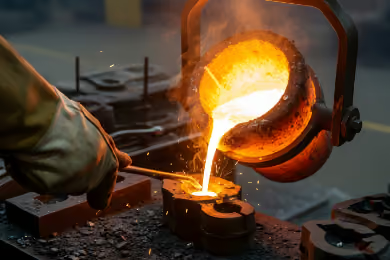
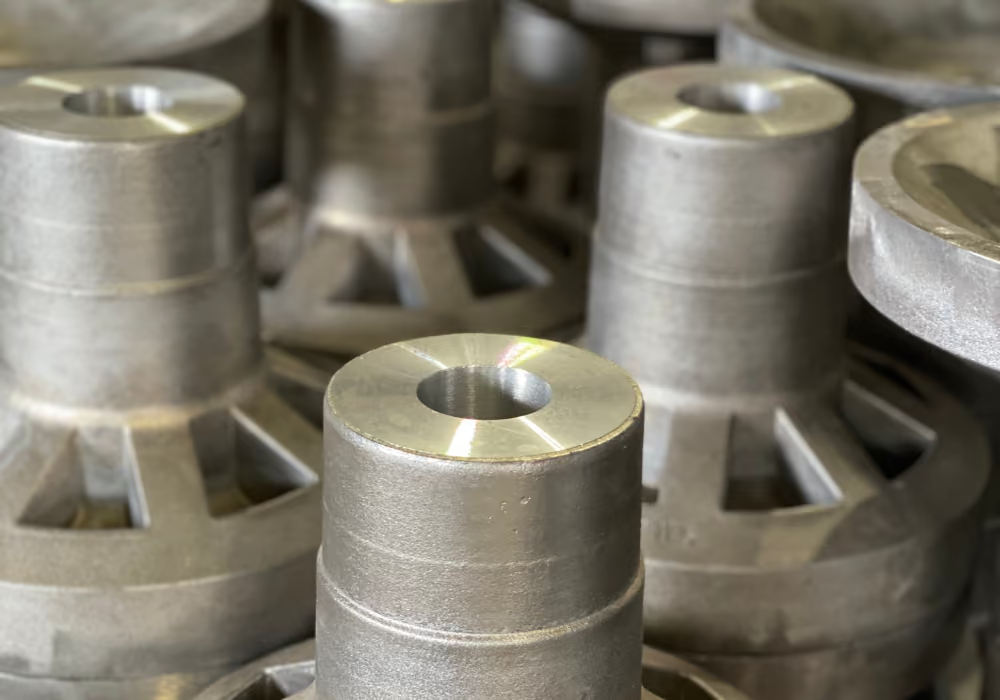
In permanent mold casting, molten metal is poured or tilted into a reusable metal die — typically machined from steel or iron — and allowed to fill under gravity. The die is coated with a release agent to prevent sticking and promote directional solidification, then opened to eject the part once solidified. Unlike sand casting, the mold is reused for thousands of cycles before requiring maintenance or replacement.

The metal mold conducts heat far more rapidly than sand, producing a faster solidification rate that results in finer grain structure and improved mechanical properties compared to sand castings of the same alloy. This makes permanent mold castings a common specification choice when fatigue strength, pressure tightness, or impact resistance is critical.

Tilt pouring is a common variant of permanent mold casting in which the mold is rotated from horizontal to vertical as metal is poured, controlling fill rate and minimizing turbulence. This further reduces porosity and oxide inclusions, producing castings of exceptional integrity — particularly valuable for hydraulic components, structural brackets, and other pressure-tight or safety-critical applications.

Sand cores can be used within permanent mold tooling to create internal passages and complex internal geometry — a capability that distinguishes permanent mold from die casting, which typically cannot accommodate loose sand cores. Semi-permanent mold casting (permanent mold with sand cores) is a well-established variant used widely in automotive engine component production.

Why Join TCMA

Grow Your Foundry With a TCMA Permanent Mold Listing

Permanent mold is one of the most underrepresented casting processes in online search — which means buyers looking for permanent mold suppliers often struggle to find qualified foundries. A TCMA verified listing puts your foundry directly in front of that underserved demand. Featured members receive priority placement on this page and homepage exposure across the full TCMA network.
Membership Tiers

Find foundries with the exact capability you need — or join TCMA to list yours.
Standard Foundry Member
$250
/ Per Year
Who it's For
Any Foundry
What You Get
Verified listing with member badge
Process Tags
Short Description
Direct contact button for buyer inquiries
Backlink to your website (SEO value)
Access to TCMA member-only resources
Concierge intro to buyers in our network
Featured Foundry Member
$450
/ Per Year
Who it's For
Foundries Wanting Top Visibility
What You Get
Everything in Standard Foundry Member
Priority placement on category landing pages
Logo & link to your website on our homepage sponsor bar
Dedicated capability landing page on TCMA
One-time "process spotlight" post for AI Search Visibility
Content via partner networks (add'l costs apply)
Join Today
Associate / Supplier
$550
/ Per Year
Who it's For
Equipment providers
Material suppliers
Software Companies
Service companies
What You Get
Logo & link to your website on our homepage sponsor bar
Dedicated Supplier Profile Page
"Recommended Partner" tag in relevant categories
Access to TCMA member-only resources
Concierge intro to buyers in our network
Purchase Membership

Not Sure if Permanent Mold Is Right for Your Project?

Tell us your alloy, volume, and part requirements — we'll assess the fit and connect you with a qualified permanent mold foundry.

Get Started Today

Fill out this short form, and someone from our team will reach out.
Thank you! Your submission has been received!
Oops! Something went wrong while submitting the form.