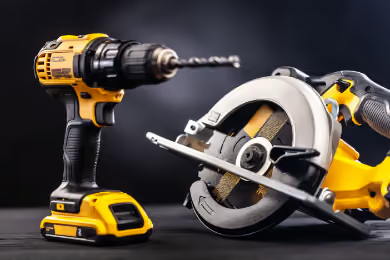
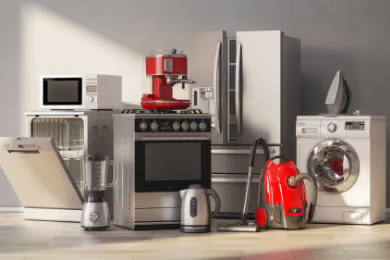
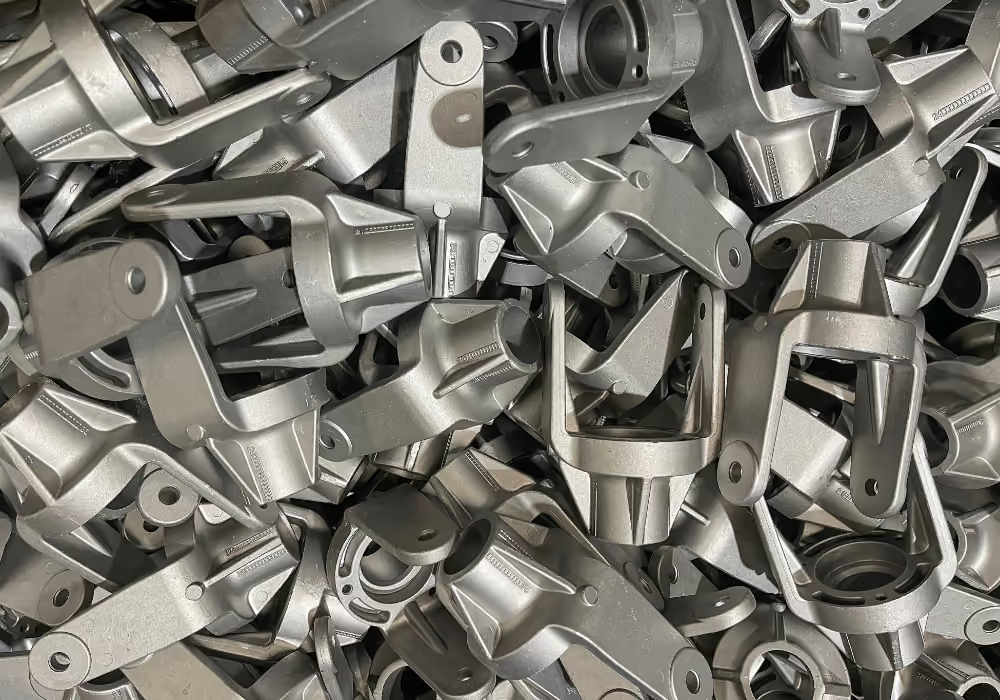
Die casting is the dominant process for high-volume, precision non-ferrous components — the reason your car's transmission housing, your power tool housing, and thousands of other everyday parts are dimensionally consistent, lightweight, and produced by the millions. When volume is high, tolerances are tight, and alloy is aluminum, zinc, or magnesium, die casting almost always wins on total cost of ownership.
TCMA's directory connects buyers directly with verified die casting manufacturers across North America. Browse listings by region and capability, or skip the search entirely — submit your project below and we'll match you with the right foundry.






Explore featured TCMA member foundries and casting suppliers serving buyers across North America.
Die casting forces molten metal under high pressure into a precision-machined steel die (tool), where it solidifies rapidly before the die opens and the part is ejected. The entire cycle — from die close to part ejection — can take as little as 15 seconds for zinc and 30–90 seconds for aluminum, enabling output rates that no other casting process approaches.
The steel dies used in die casting are the process's primary cost driver and its greatest competitive advantage simultaneously. A single die can produce hundreds of thousands of parts with consistent dimensions, surface finish, and wall thickness — the repeatability is unmatched. However, die tooling typically costs between $10,000 and $100,000+ depending on part size, complexity, and number of cavities, which makes die casting economically unsuitable for low-volume production.
Die casting is also notable for what it can eliminate downstream. Well-designed die cast parts often require minimal machining — holes, threads, bosses, and complex external features can be cast in. Design for die casting (DFDC) is a discipline in itself, and the best die casting foundries will engage in design review before tooling to help customers minimize per-piece cost and maximize casting yield.
Porosity management is the primary quality challenge in die casting. High injection pressure can trap air in the mold, creating subsurface voids that weaken parts or cause leak failures. Premium foundries address this through vacuum-assisted die casting, optimized gate and runner design, and rigorous in-process inspection including X-ray. When evaluating a die caster for a structural or pressure-tight application, ask specifically about their porosity mitigation process.
"Die casting companies" is one of the most searched terms in manufacturing procurement — buyers know what they want, and they search for it specifically. A verified TCMA listing puts your foundry in front of that traffic with your alloys, capabilities, and location clearly indexed. Featured members appear at the top of this page and on the TCMA homepage sponsor bar, ensuring maximum visibility when buyers are actively sourcing.
Tell us your alloy, volume, and part requirements — we'll connect you with a verified die casting manufacturer that fits your application and timeline.