Sand casting is the most widely used metal casting process in the world — and for good reason. It accommodates virtually any metal, any part size, and almost any level of complexity, making it the default starting point for engineers and buyers sourcing new cast components.
Whether you're sourcing a few prototype castings or tens of thousands of production parts annually, TCMA's directory connects you directly with verified sand casting manufacturers who specialize in exactly what you need. Not sure which foundry is right for your application? You don't have to figure that out alone — submit your project details below and we'll match you with the right supplier.


Explore featured TCMA member foundries and casting suppliers serving buyers across North America.
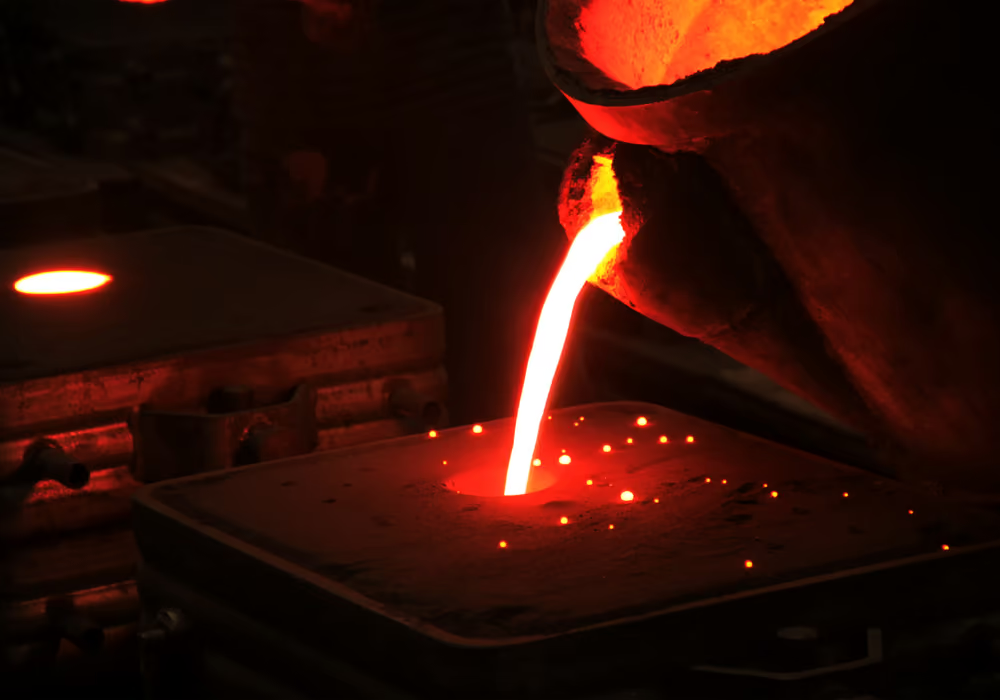
Sand casting uses a sand-based mold — typically green sand (clay-bonded) or chemically bonded no-bake sand — formed around a pattern of the desired part. Once the pattern is removed, molten metal is poured into the cavity, allowed to solidify, and the mold is broken away to reveal the casting. The process can be repeated with new sand for each cycle, keeping tooling costs low and production flexibility high.
The two dominant sand casting methods you'll encounter are green sand and no-bake (air-set). Green sand is the industry workhorse — high-speed, low-cost, and ideal for iron and aluminum production runs. No-bake uses chemically bonded sand that cures at room temperature, offering better dimensional accuracy and surface finish at slightly higher per-unit cost — common for steel castings and larger, more complex parts.
Shell molding is a third variant worth knowing: resin-coated sand is cured against a heated pattern, producing a thin, dimensionally accurate mold shell. It bridges the gap between green sand economics and investment casting precision, and is particularly well-suited for ferrous parts in medium production volumes.
Sand casting tolerances typically run from ±0.03" to ±0.06" depending on alloy, part geometry, and foundry capability. As-cast surface finish generally ranges from 250 to 500 Ra. Most production sand castings involve some degree of machining for critical dimensions — this should be factored into your RFQ from the start.
Pattern tooling is the primary upfront cost in sand casting. Matchplate patterns (for smaller, automated green sand work) and cope-and-drag patterns (for larger or more complex work) are typically made from aluminum, urethane, or wood depending on volume and budget. Tooling costs range from a few hundred dollars for simple patterns to tens of thousands for complex production tooling — but remain dramatically lower than die casting tooling investment.
Sand casting is searched by buyers every day. Procurement teams, engineers, and OEM supply chain managers are actively looking for qualified foundries — and increasingly, they're using Google and AI-powered tools to find them. A verified TCMA listing ensures your foundry appears in those searches with your capabilities, certifications, and contact information front and center.
Featured members receive priority placement at the top of this page, a dedicated capability landing page on TCMA.com targeting your specific alloys, industries, and geography, and homepage visibility that drives brand recognition across the entire site. Whether you're a 3-person job shop or a fully automated high-volume foundry, TCMA gives you a platform designed specifically for the casting industry.
Skip the research. Tell us about your part — alloy, tolerance requirements, industry, and annual volume — and we'll connect you with a verified investment casting foundry that fits.