Investment casting — also called lost wax casting — is the process of choice when precision, surface finish, and alloy flexibility matter more than tooling cost. It's the go-to solution for aerospace components, surgical instruments, firearms parts, turbine blades, and any application where tight tolerances and complex geometry must coexist.
TCMA's directory lists verified investment casting manufacturers across the country, organized so buyers can find the right foundry quickly. If you'd rather not evaluate suppliers on your own, submit your project below — we'll review your requirements and connect you with the right match.

Explore featured TCMA member foundries and casting suppliers serving buyers across North America.
Investment casting begins with an injection-molded wax pattern — an exact replica of the finished part. Multiple wax patterns are assembled onto a central wax "tree" and repeatedly dipped into a ceramic slurry, building up a hard ceramic shell around the assembly. The wax is then melted out (hence "lost wax"), leaving a hollow ceramic mold that is fired at high temperature to develop strength.
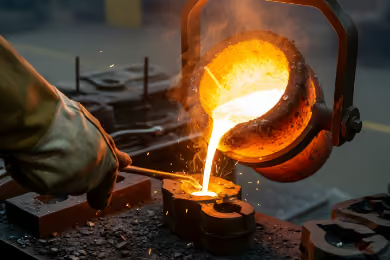
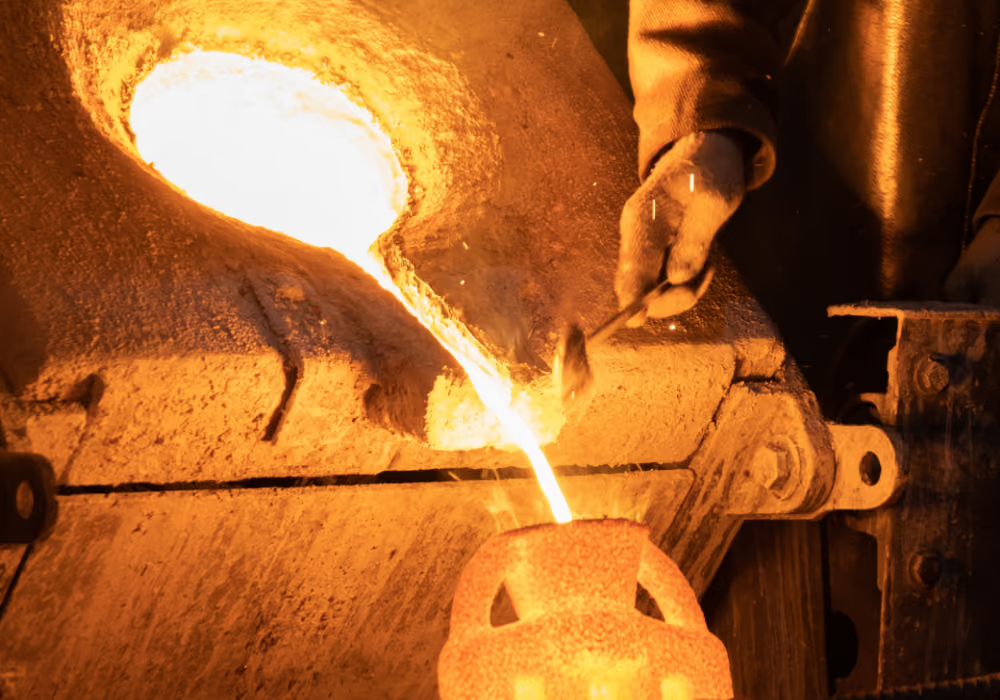
Molten metal is poured into the preheated ceramic mold, which is then broken away after solidification. The result is a near-net-shape casting with excellent surface detail, dimensional accuracy, and minimal draft requirements — characteristics no other casting process can match across the full range of engineering alloys.
The investment casting process supports an exceptionally broad alloy range, including high-temperature nickel and cobalt superalloys that cannot be cast in permanent dies. This makes it indispensable in aerospace and power generation, where material performance is non-negotiable.
Tooling for investment casting consists of metal injection dies (for wax pattern production), typically machined from aluminum or steel. Die costs generally range from $1,500 to $15,000+ depending on part complexity and production volume — higher than sand casting patterns but still far below die casting tooling. Once tooling is amortized, investment casting delivers competitive per-piece economics for complex parts that would otherwise require extensive CNC machining from billet.
Dimensional tolerances for investment casting typically run ±0.005" per inch, and as-cast surface finish averages 63–125 Ra — often eliminating the need for machining on non-critical surfaces entirely.
Buyers searching for investment casting suppliers are often working on high-value, specification-driven projects — aerospace qualifications, medical device supply chains, defense contracts. These buyers search specifically and they need to trust who they source from. A verified TCMA listing demonstrates that your foundry is part of a credible, vetted industry network.
Featured investment casting members receive top-of-page placement on this directory, a capability landing page targeting your specific alloys and certifications, and homepage exposure to buyers and procurement professionals visiting TCMA from across the country.
You don't have to sort through listings and make cold calls. Tell us about your project and we'll connect you with a qualified sand casting manufacturer that fits your alloy, volume, and timeline.