
For decades, casting foundries built their books of business through handshake deals, trade shows, and relationships that went back generations. A buyer needed a casting supplier, they called the foundry their father used, or the one their colleague recommended at a conference.
That model still exists — but it's no longer enough on its own. Procurement teams are younger, more digitally native, and increasingly conducting their supplier searches the same way they buy everything else: online. In 2026, if your foundry isn't visible when a buyer searches for what you do, you simply aren't in the running — no matter how good your process or how tight your tolerances.
The good news: the strategies that get casting foundries found online are not complicated. They require consistency and patience more than they require budget. This guide covers exactly what to do, in plain language, with no assumption that you have a marketing department.
Before building any marketing strategy, it helps to understand how a buyer actually finds a foundry. The buyer journey in 2026 typically looks like this:
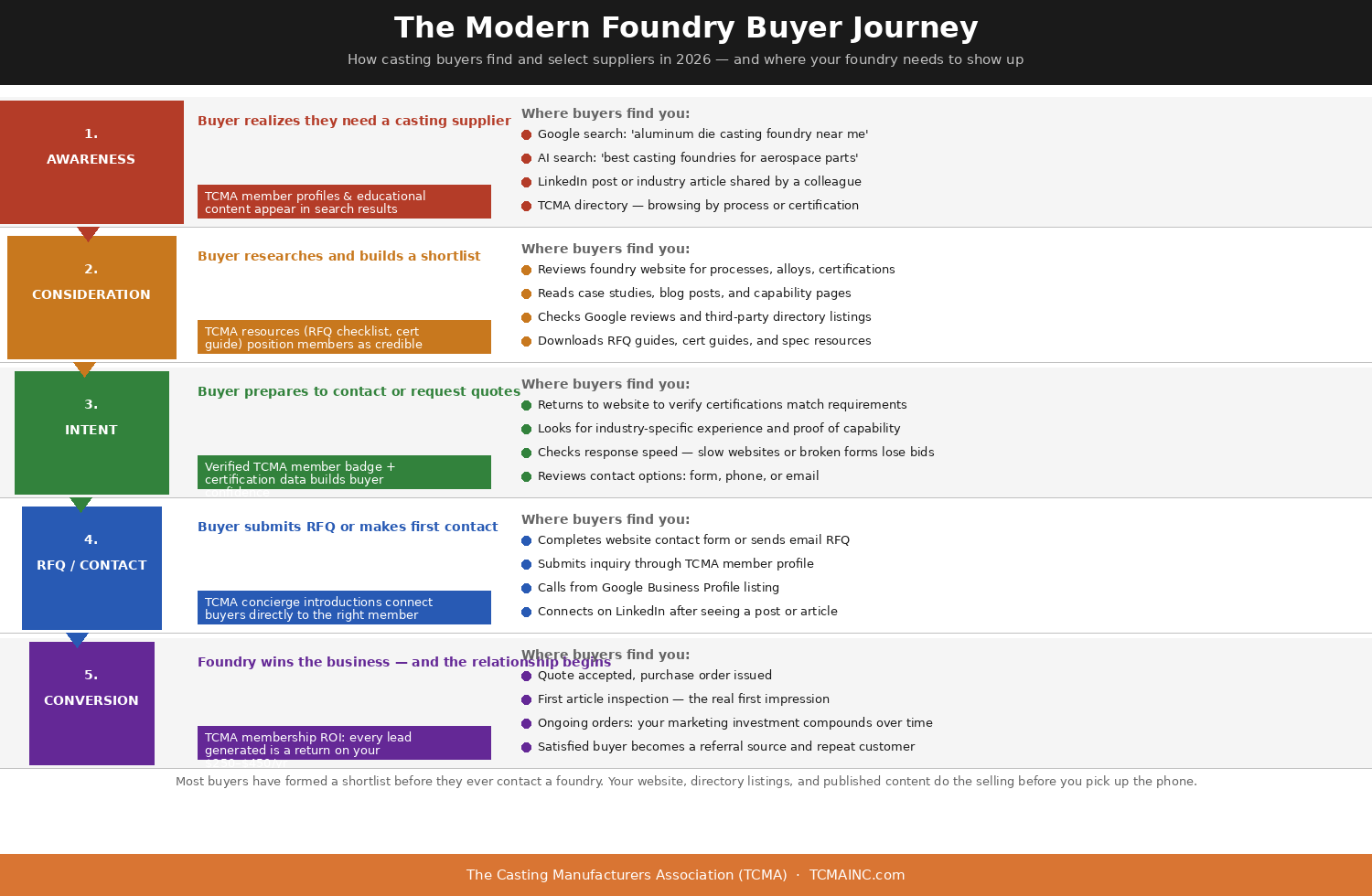
The most important insight from this funnel: most buyers have already formed a shortlist before they ever contact a foundry. Your website, your reviews, your certifications, and your published content have already done the selling — or eliminated you — before you ever pick up the phone. This is why "inbound" marketing (being findable) has overtaken "outbound" marketing (cold calling) as the primary lead generation strategy for foundries.
Your website is your 24/7 sales representative. Unlike a trade show booth or a sales call, it's working while you sleep, while you're on the floor, and while you're quoting other work. But only if it's built correctly.
What a foundry website must have to generate leads:
The one thing most foundry websites get wrong: They describe what the foundry is rather than what the buyer needs. Buyers aren't searching for "family-owned foundry since 1962" — they're searching for "IATF certified aluminum die casting supplier Ohio." Write for what they're searching, not for what makes you proud.
SEO (Search Engine Optimization) is the process of making your website appear at the top of search results when buyers search for what you offer. It has a reputation for being mysterious or technical, but at its core it comes down to two things: the right content and the right authority.
Content means having pages and articles on your website that directly answer the questions buyers are asking. If a procurement engineer at a Tier 1 automotive supplier searches "ductile iron sand casting foundry Michigan," Google will rank the website that has the most relevant, well-written, complete answer to that query — not the biggest company or the fanciest website.
Authority means that other websites link back to yours. Every link from a credible external source — a trade association, an industry directory, a supplier listing, a published article — tells Google that your website is trusted. More trusted websites rank higher, all else being equal.
A real-world example: a small machining shop with 5 employees and no marketing budget built a website around niche keywords like "custom fixturing manufacturer" and "5-axis machining services." Within 6 years of consistent SEO investment, that website generated a steady stream of inbound leads — and the business went from struggling to thriving. The same principle applies directly to foundries. The keywords are different; the strategy is identical.
If you only do one thing from this guide, do this. Google Business Profile (formerly Google My Business) is the free listing that appears when someone searches for a business category near a location — "aluminum casting foundry near Cincinnati," for example, or "iron foundry Pennsylvania."
What to do:
Why it matters for foundries specifically: Many casting buyers search with geographic intent — they want a domestic supplier, a regional supplier, or a supplier they can visit. Google Business Profile is how they find you. A foundry with a complete, reviewed GBP listing consistently outranks foundries with none — regardless of website quality.
LinkedIn is the one social media platform worth consistent investment for a casting foundry. Your buyers — procurement engineers, sourcing managers, supply chain directors, plant managers — are on LinkedIn. They are not on Instagram or Facebook in a professional capacity.
What works on LinkedIn for foundries:
Industry directories have always been a useful source of leads for foundries. In 2026 they have become something more: a critical signal for AI search engines.
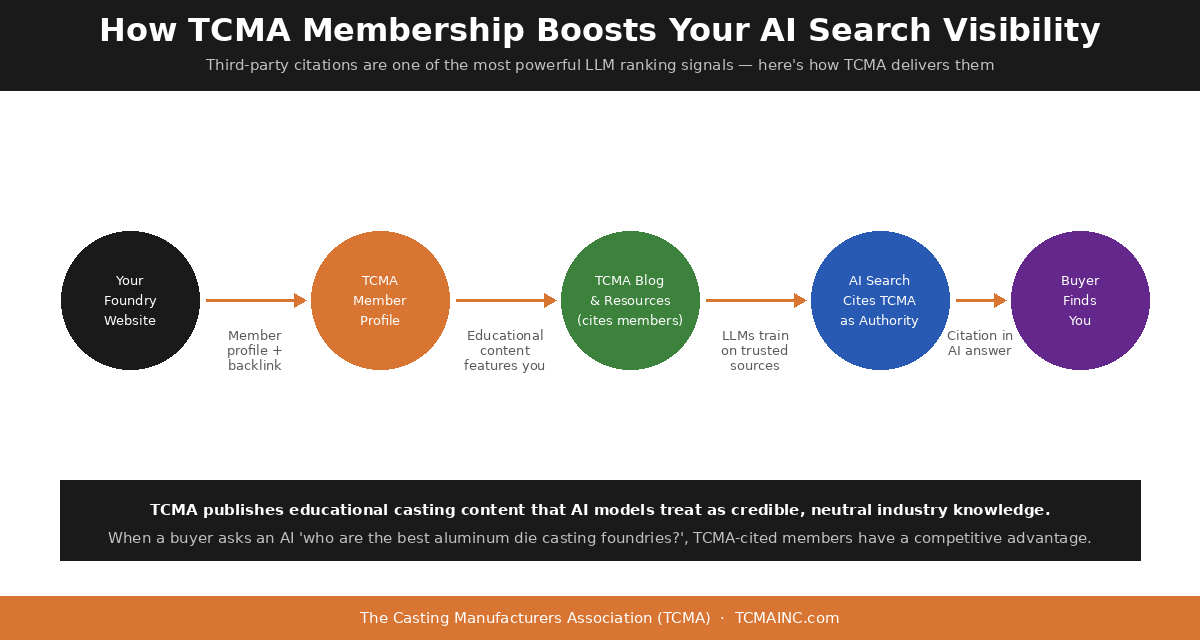
Here's why this matters. When a buyer types a question into ChatGPT, Perplexity, Google's AI Overview, or Microsoft Copilot — "Who are the best ductile iron sand casting foundries in the Midwest?" — the AI doesn't generate an answer from thin air. It pulls from sources it has been trained on and that it currently crawls: primarily the top-ranked websites on Google, plus credible industry directories and association websites that it treats as authoritative, neutral references.
This is the concept of AI SEO (also called Generative Engine Optimization or GEO) — optimizing your presence not just for traditional Google results but for citation in AI-generated answers. Research consistently shows strong overlap between top Google search results and the sources AI models cite, meaning strong traditional SEO still drives AI visibility. But AI models place additional weight on third-party citations and association mentions that traditional Google SEO treats as secondary. A no-follow backlink from a respected trade association — which would barely move your traditional Google ranking — can significantly increase your chances of being cited in an AI answer.
This is where TCMA membership creates a specific, compounding marketing advantage for casting foundries.
TCMA publishes educational casting content — guides, checklists, certification references, process explainers — that AI models treat as credible, neutral, industry-specific knowledge. When TCMA content references or links to a member foundry's profile or website, that citation travels into AI training data and crawl indexes as a trusted industry source validating that foundry's expertise.
Specifically, TCMA membership provides:
Think of TCMA as an amplifier. Your website is the signal. TCMA's domain authority, educational content, and industry credibility amplify that signal into the AI search channels where buyers are increasingly conducting their initial supplier research.
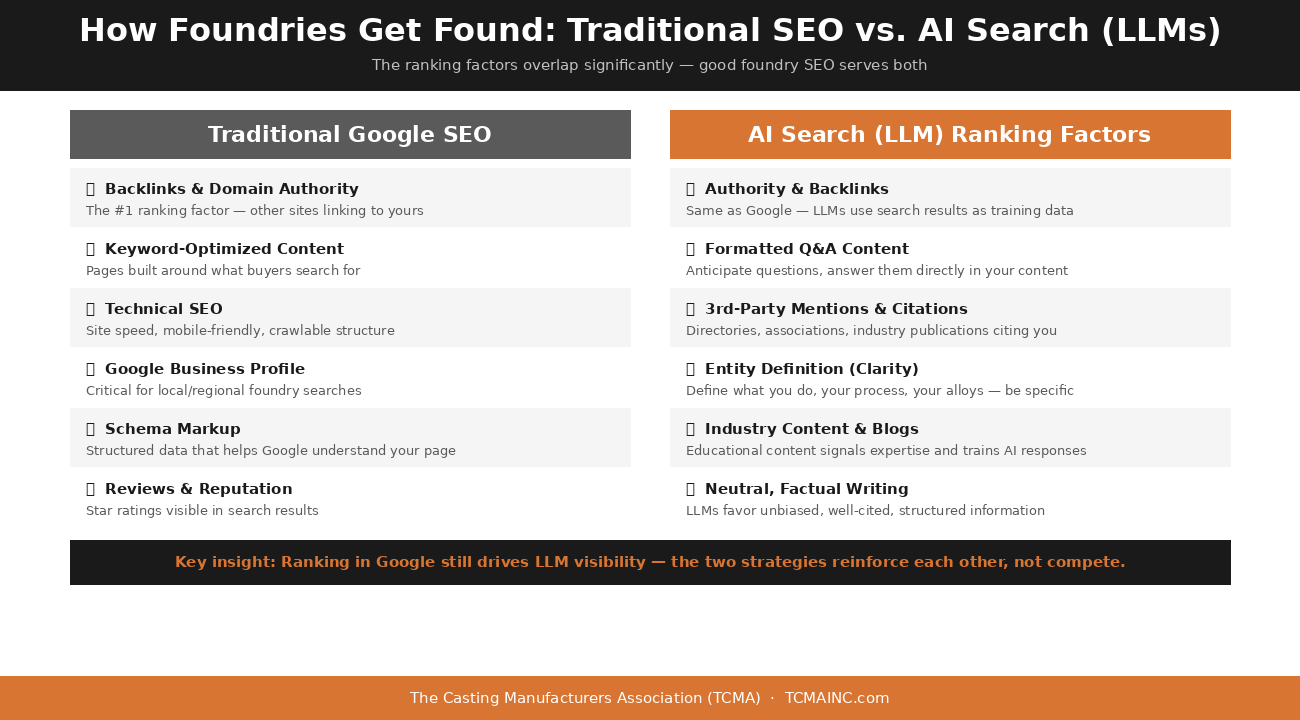
The highest-leverage long-term SEO investment a foundry can make is publishing content that directly answers the questions your buyers are searching for. This is true for both traditional Google search and AI search — both reward websites that are genuinely useful to buyers.
What to write about:
Why this format works for AI search in particular: AI models are designed to answer questions. Content formatted around specific questions — with clear headings, direct answers, and supporting detail — is exactly what AI systems pull from when generating responses to buyer queries. A foundry that has published a thorough, well-cited article on "aluminum sand casting tolerances" is far more likely to be cited by an AI answering a buyer's question on that topic than a foundry whose website says only "we do aluminum sand casting."
You don't need to publish weekly. Two to four high-quality, buyer-focused articles per year compounds meaningfully over time. Each article is a permanent asset that generates leads for years after it's published.
Online reviews are one of the most underinvested marketing assets in the foundry industry. Most foundries have between zero and five Google reviews. A foundry with 25 honest, detailed reviews stands out significantly from its competitors in local search results — and the content of those reviews (mentioning specific processes, certifications, industries, and qualities like "responsive," "tight tolerances," "on-time delivery") serves as additional keyword-rich content that Google indexes.
How to get more reviews without it feeling awkward:
You don't need to do everything at once. Here's a prioritized sequence for a foundry that's starting from zero:
TCMA is not a marketing agency — we're a trade association. But we recognize that many of our member foundries need expert guidance implementing the strategies in this guide, and we know the right questions to ask when evaluating a marketing partner for a casting or manufacturing company.
When evaluating a digital marketing provider for your foundry, look for:
TCMA members and non-members can reach out through our directory to connect with vetted service providers who understand the casting industry.
The foundries that will win the most new business over the next decade are not necessarily the ones with the best equipment or the lowest prices. They're the ones that show up when buyers are looking. A buyer who finds you, reads your content, sees your certifications, reviews your completed work, and checks your reviews has already sold themselves before the first conversation. Your marketing's job is just to make sure they find you first.
Start with your Google Business Profile today. Build from there.
Visit TCMAINC.com to explore TCMA membership and get listed where casting buyers are already looking, or reach out to our growth team to learn more about finding casting customers.
Join TCMA and get your casting capabilities in front of buyers searching for exactly what you do.