
A plain-language breakdown of quality certifications for casting buyers, foundries, and their supply chains
Published by The Casting Manufacturers Association (TCMA)
TCMAINC.com
Quality certifications exist for one reason: to give buyers confidence that a supplier's processes are controlled, repeatable, and audited by a third party. In the casting industry, certifications are often required by contract, mandated by end customers, or specified in industry standards — but they're also frequently over-specified, misunderstood, or applied to situations where they add cost without adding value.
This guide covers the certifications you'll encounter most often when sourcing or supplying cast metal components. For each one, we explain what it actually covers, which industries require it, and — critically — when you genuinely need it vs. when you're adding unnecessary burden to your supply chain.
For foundry owners, we've also included a process-by-process guide to help you evaluate whether pursuing certification makes financial sense for your business — because the honest answer isn't the same for every foundry.
ISO 9001 is the world's most widely adopted quality management system standard, published by the International Organization for Standardization. The current version is ISO 9001:2015. It defines requirements for how an organization documents, controls, monitors, and improves its processes — not what specific outcomes must be achieved, but how a quality system must be structured and maintained.
ISO 9001 certification means a third-party registrar has audited the organization and confirmed its QMS meets the standard's requirements. Recertification audits occur every three years, with annual surveillance audits in between.
ISO 9001 is a process standard, not a product standard. A foundry can be ISO 9001 certified and still produce castings that don't meet your requirements — the certification means they have a system for identifying and responding to problems, not that problems won't occur. It does not cover industry-specific requirements or special process accreditation.
ISO 9001 should be your minimum supplier quality requirement for any production casting program. If a foundry doesn't hold ISO 9001, ask why — for any volume production supplier, the absence is a yellow flag.
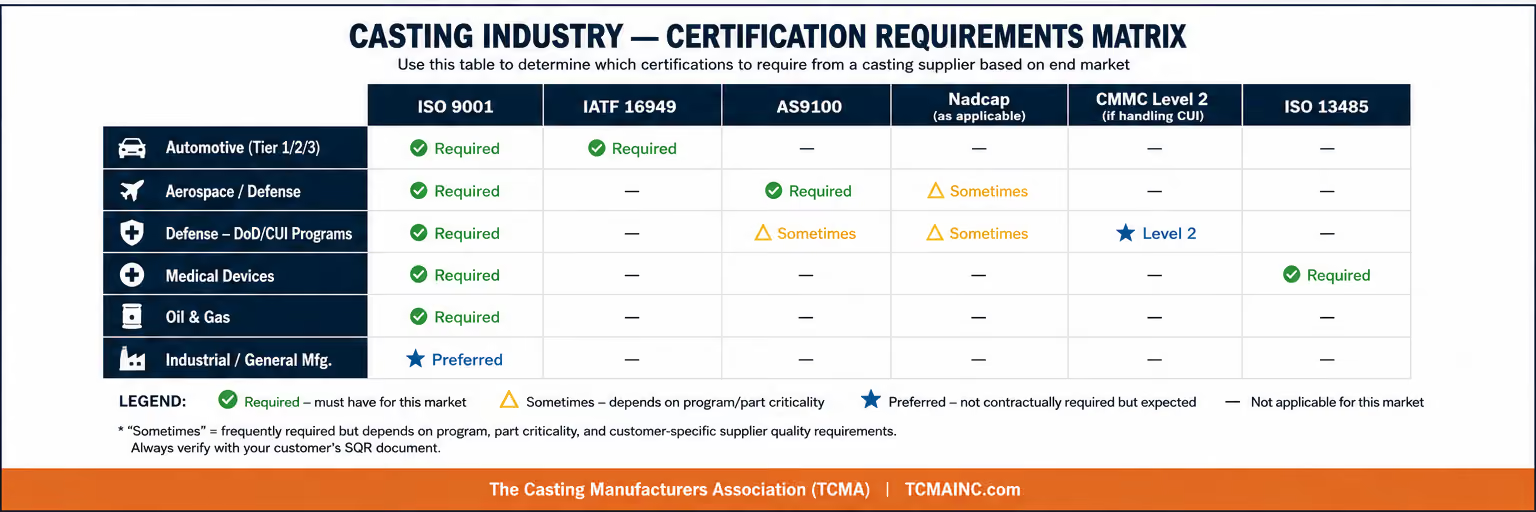
If your application is automotive, aerospace, defense, or medical, ISO 9001 alone is insufficient. Those industries have built sector-specific standards on top of ISO 9001 that address requirements unique to their supply chains.
IATF 16949 is the quality management standard for automotive production and relevant service parts, published by the International Automotive Task Force. The current version is IATF 16949:2016. It is built on ISO 9001 and adds extensive automotive-specific requirements. A foundry that is IATF 16949 certified is also ISO 9001 certified.
Require IATF 16949 when your castings are destined for automotive OEM production programs, safety-critical automotive components, or any program where your customer contractually requires it.
If your application is not automotive, IATF 16949 is irrelevant. Requiring it outside automotive programs adds certification maintenance cost with no practical benefit.
IATF 16949 certification is scope-specific to the manufacturing site and product families covered. A foundry may hold it for die casting but not sand casting. Always confirm the certification scope matches your program.
AS9100 is the quality management standard for aviation, space, and defense, published by SAE International and IAQG. The current version is AS9100 Rev D (2016). Like IATF 16949, it is built on ISO 9001 and adds aerospace-specific requirements. AS9100 certification includes ISO 9001 compliance.
Require AS9100 when castings are used in commercial aircraft, military systems, spacecraft, jet engine components, or any program where your customer contractually requires it.
AS9100 governs the overall quality system. Nadcap accredits specific high-risk processes. Aerospace programs often require both — they are complementary, not interchangeable.
Nadcap is managed by the Performance Review Institute (PRI) on behalf of major aerospace and defense OEMs including Boeing, Airbus, Lockheed Martin, GE Aviation, and Pratt & Whitney. Unlike quality management standards, Nadcap accredits specific manufacturing processes considered high-risk in aerospace supply chains. It is a collection of commodity-specific accreditations, each audited separately.
Nadcap is required when your end customer is a Nadcap-subscribing aerospace OEM, the process is designated as a special process in their supplier requirements, or the contract specifically calls it out. It is generally not required for ground support equipment, non-flight hardware, or commercial industrial applications.
AS9100 does not automatically require Nadcap. Nadcap is a separate requirement that must be explicitly called out in the contract. Always check your customer's Approved Supplier List and supplier quality requirements document before imposing Nadcap on a foundry.
Verify Nadcap accreditation through PRI's eAuditNet database at eauditnet.com. Each commodity scope is listed separately with current status and expiry.
CMMC is a Department of Defense requirement for contractors and subcontractors who handle Federal Contract Information (FCI) or Controlled Unclassified Information (CUI) in connection with DoD contracts. It matters to the casting industry because defense contractors increasingly include foundries in their supply chains — and the question of whether a casting supplier needs CMMC is genuinely complex and frequently misunderstood.
CMMC Level 1 — Foundational
17 basic cybersecurity practices aligned with FAR 52.204-21. Covers access control, authentication, media protection, physical protection, and system integrity. Self-assessment permitted — no third-party audit required. Required for any company handling FCI but not CUI.
CMMC Level 2 — Advanced
110 practices aligned with NIST SP 800-171. The level most defense subcontractors handling CUI need to achieve. Third-party assessment by a C3PAO (Certified Third-Party Assessment Organization) required for most programs. This is the primary CMMC focus for manufacturing supply chain companies, including foundries on defense programs.
CMMC Level 3 — Expert
110+ practices from NIST SP 800-171 plus NIST SP 800-172. Assessed by DCMA directly. Required only for highest-priority DoD programs. Most commercial foundries will not reach this level.
The answer depends on one question: Does your casting supplier receive, process, store, or transmit Controlled Unclassified Information (CUI)?
CUI in a casting context typically includes controlled engineering drawings, program-specific technical data packages, and export-controlled material specifications.
Scenario 1 — You're a Tier 1 prime with CMMC Level 2 sending a controlled drawing to a foundry.
If that drawing contains CUI, you've transmitted CUI to your subcontractor. They are required to meet CMMC Level 2. Your certification does not cover them.
Scenario 2 — You're a Tier 2 supplier sharing a controlled drawing with a Tier 3 casting foundry.
Same logic. The CMMC obligation flows with the information, not with the company's tier position. If the foundry receives CUI, they need CMMC Level 2.
Scenario 3 — You're a Tier 2 or Tier 3 foundry receiving only a PO (no technical drawing) and shipping finished castings.
If you never receive, process, or store CUI — you receive only a purchase order and ship parts — you likely need only CMMC Level 1. Confirm with your customer's flow-down requirements and legal counsel.
Scenario 4 — You're a foundry casting parts under a commercial drawing not designated as CUI.
If the drawing is not designated CUI, you may not need CMMC Level 2 — but get written confirmation from your customer. "It's probably fine" is not adequate documentation if DoD audits the prime.
More information: ac.cto.mil/cmmc and cyberab.org
ISO 13485 — Medical Devices
Required when castings are used in implantable devices, surgical instruments, or diagnostic equipment. Shares structure with ISO 9001 but adds FDA and MDR regulatory compliance requirements. Most foundries supplying medical casting work will need it unless the customer has specifically waived it.
ITAR — International Traffic in Arms Regulations
Not a certification — a US export control regulation governing defense articles on the US Munitions List. If your castings are components of USML defense systems, you and your suppliers may need ITAR registration with the State Department's DDTC. Violations carry severe criminal and civil penalties. Confirm with legal counsel.
AIAG Standards (PPAP, APQP, FMEA, MSA, SPC)
Not certifications but documented methodologies referenced in IATF 16949. Required competency for automotive casting supply chains. Every automotive casting foundry must be able to execute PPAP competently.
API Certifications — Oil & Gas
Product and quality standards for oil and gas applications including API 6A (wellhead equipment) and API 11B. Product-specific and may be required for pressure-containing or safety-critical components.
Certification is not the right investment for every foundry — and pretending otherwise wastes money and management bandwidth. Here is an honest, process-by-process assessment of whether certification is likely to generate a return for your business.
The cost baseline: ISO 9001 certification for a small-to-medium manufacturer typically runs $7,000–$50,000 over a 3-year certification cycle when you factor in consulting, registrar fees, surveillance audits, and internal staff time. IATF 16949 and AS9100 add cost on top of that. Nadcap is the most expensive — typically $15,000–$40,000+ per scope for the initial audit plus ongoing surveillance. The question is whether the market access unlocked by certification justifies that investment.
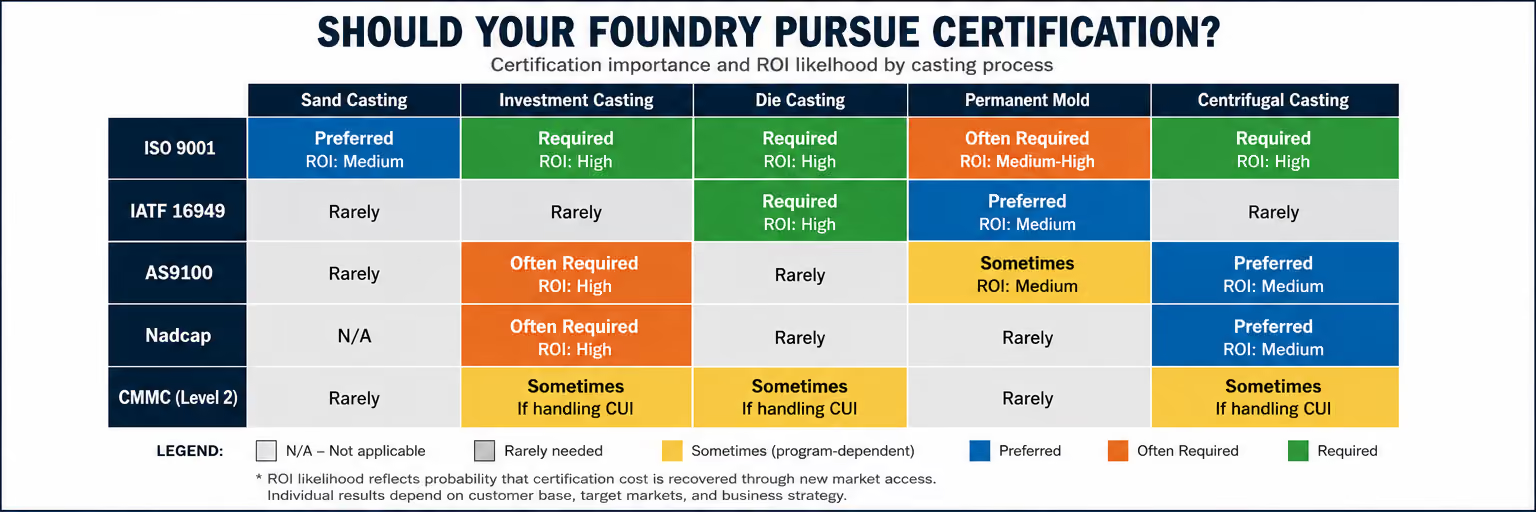
The least certified segment of the casting industry — and for many sand casting operations, that's a rational business decision. Most sand casting foundries serve industrial, agricultural, municipal, and general OEM markets where ISO 9001 is preferred but rarely contractually required. If you're running a job shop serving diverse local and regional customers with no automotive, aerospace, or defense concentration, ISO 9001 may not pay back quickly on its own.
However, ISO 9001 certification consistently correlates with improved internal efficiency — foundries that go through the process report reductions in scrap, rework, and customer complaint frequency that generate real savings regardless of whether any new customer requires it. The better question for a sand casting foundry isn't "will a customer require this?" but "which customers am I currently losing because I don't have it?" If the answer is more than one or two per year, the ROI case is likely already there.
Rule of thumb for sand casting: If more than 20% of your target new business requires ISO 9001 — or if you're losing bids to certified competitors — pursue it. If your market is genuinely indifferent, evaluate the internal efficiency ROI on its own merits.
The most certification-dense casting segment. Aerospace, defense, and medical — the primary markets for investment casting — all require AS9100, IATF 16949, or ISO 13485 respectively. Most investment casting foundries doing meaningful volume already hold at least ISO 9001, and a large percentage hold AS9100. If you're an investment caster without ISO 9001, you are very likely already losing bids to certified competitors.
Rule of thumb for investment casting: ISO 9001 is effectively mandatory. AS9100 is a near-requirement for any aerospace or defense market participation. The ROI is high — one aerospace qualification enabled by AS9100 certification can return the entire certification investment in a single program.
Heavily automotive-facing. IATF 16949 is standard for die casters supplying Tier 1 and Tier 2 automotive programs. Non-automotive die casters serving consumer products, electronics, and general industrial markets can operate effectively on ISO 9001 alone.
Rule of thumb for die casting: If automotive is any meaningful portion of your target market, IATF 16949 is effectively required — most automotive OEM qualification processes won't proceed without it. For non-automotive die casters, ISO 9001 is the right level.
Mixed picture that mirrors sand casting in non-automotive markets and die casting in automotive-facing ones. Automotive permanent mold foundries casting aluminum suspension and powertrain components need IATF 16949. Non-automotive permanent mold shops serving industrial and general OEM work can often operate on ISO 9001.
Rule of thumb for permanent mold: The certification decision follows your customer base. Map your top 10 customers and prospects — if the majority are automotive, invest in IATF 16949. If they're diversified industrial, ISO 9001 is appropriate.
Primarily energy, marine, and industrial markets with a significant aerospace segment. ISO 9001 is widely expected across all centrifugal casting markets. AS9100 is required for aerospace-specification centrifugal castings. Nadcap Casting accreditation is relevant for flight-critical aerospace centrifugal components.
Rule of thumb for centrifugal casting: Certification ROI is exceptionally high in this segment because the per-unit value of centrifugal castings is large. A single energy or aerospace contract enabled by AS9100 or Nadcap accreditation can return the entire certification investment in one transaction. ISO 9001 should be considered baseline. AS9100 warrants serious evaluation for any foundry with aerospace ambitions.
Never rely solely on a supplier's self-reported certification list.
ISO 9001 / IATF 16949: Contact the registrar directly (Bureau Veritas, TÜV Rheinland, BSI, NSF, etc.) and use their online certificate verification tool. Confirm scope, issue date, and expiry date.
AS9100: Verify through the OASIS database at oasis.iaqg.org. Search by company name or CAGE code. OASIS is the authoritative source for AS9100 status.
Nadcap: Verify through PRI's eAuditNet at eauditnet.com. Each commodity scope is listed separately with current accreditation status and expiry.
CMMC: Once fully in effect, verify through the DoD Supplier Performance Risk System (SPRS). Ask subcontractors for their C3PAO assessment letter and SPRS score.
General rule: Request a copy of the current certificate and independently verify through the registrar or database. Add certification verification to your annual supplier review process for long-term programs.
TCMA's directory includes verified foundry profiles with certification information included in member listings. Browse by process type and shortlist suppliers that meet your qualification requirements.
Not sure which certifications to require for your specific application? Submit your project details at TCMAINC.com and we'll help you identify the right foundry with the right credentials for your program.
Visit TCMAINC.com to browse verified casting manufacturers.
Published by The Casting Manufacturers Association | TCMAINC.com | Supporting North American foundries and the buyers who rely on them