
A practitioner's guide to understanding what drives casting cost — and how to manage it
Published by The Casting Manufacturers Association (TCMA)
TCMAINC.com
If you've sent the same casting RFQ to five foundries and received five dramatically different prices, you're not alone. Casting is one of the most difficult manufactured components to price-compare because a quote isn't just a number — it's a set of assumptions about yield, tooling amortization, process parameters, secondary operations, and commercial terms that may vary significantly from one foundry to the next.
This guide breaks down the ten variables that most significantly influence casting cost. Understanding them won't make you a foundry cost estimator, but it will make you a better buyer — one who can ask the right questions, negotiate intelligently, and avoid the hidden cost traps that inflate total cost of ownership long after the initial PO is placed.
For foundry owners and estimators, this guide also serves as a practical framework for explaining your pricing to customers in a way that builds trust rather than inviting pushback.
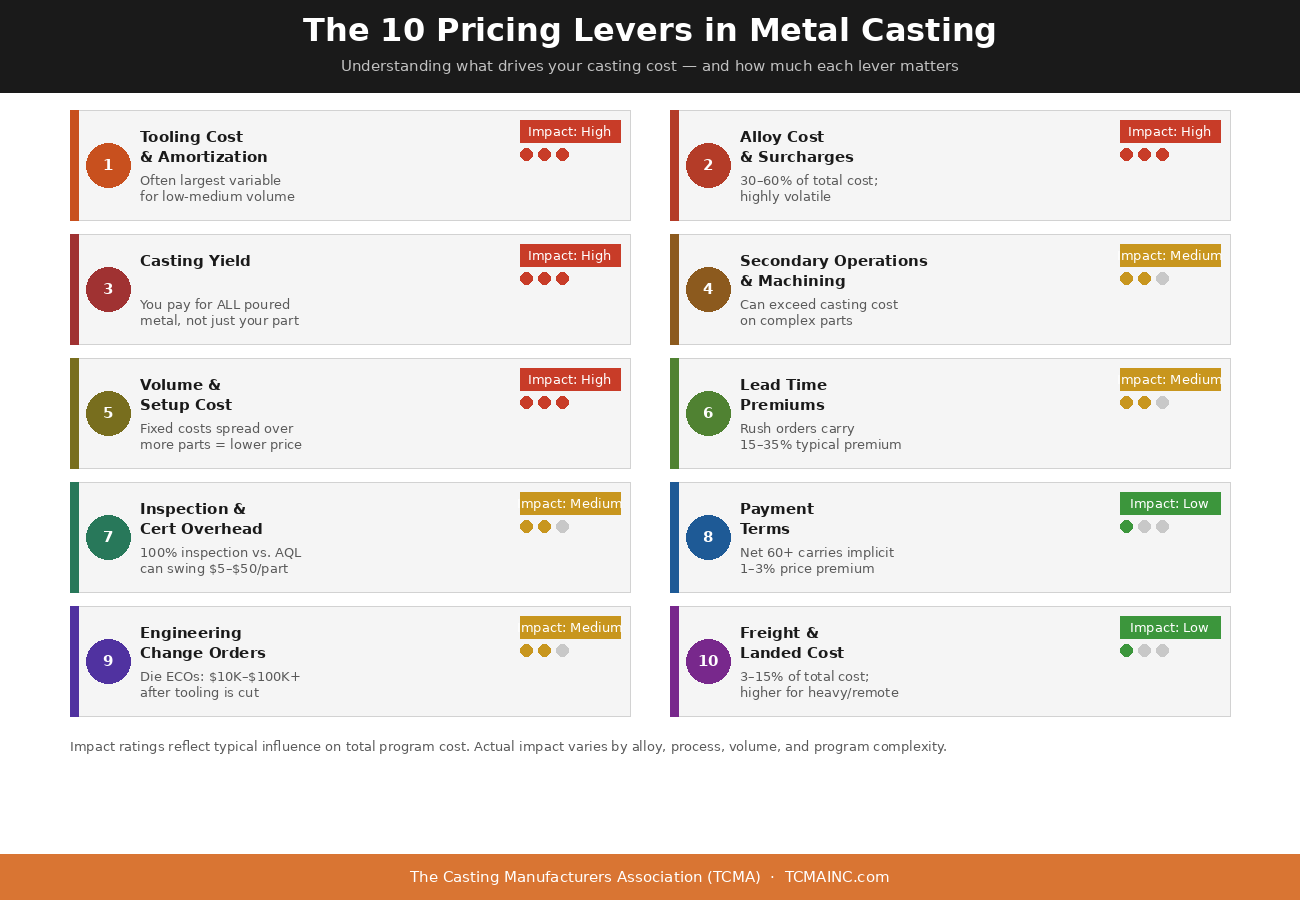
Tooling is the single largest variable in casting cost for low-to-medium volume programs — and the one most commonly mishandled in buyer-supplier negotiations.
What it is: Every casting process requires tooling — a pattern (sand casting), die (investment casting or die casting), mold (permanent mold), or centrifuge mold. Tooling is either quoted as a separate line item (you pay upfront) or amortized into the per-piece price (the foundry recoups it over a production run).
How it affects per-piece price:
If a die costs $40,000 and is amortized over 20,000 pieces, that's $2.00/piece in tooling cost alone. Run 100,000 pieces and it drops to $0.40/piece. This is why per-piece prices often drop significantly between prototype, pilot, and full production volumes — it's not always direct labor or material getting cheaper, it's tooling amortization spreading across more units.
What buyers get wrong:
What to ask your foundry:
"Is tooling quoted separately or amortized into the piece price? Who owns the tooling after it's paid for? What is the tooling's expected life (number of shots or pours), and what happens to my per-piece price when it needs replacement?"
Negotiating tip: On high-volume programs, negotiate tooling ownership upfront. If you own the tooling, you control dual-sourcing. If the foundry owns it, you're locked in.
Raw material typically represents 30–60% of a casting's total cost depending on the alloy, part weight, and process. It's also one of the most volatile components of your casting price.
How alloy pricing works:
Most foundries price castings using a base alloy price (often indexed to the London Metal Exchange or published commodity indices) plus a conversion cost (labor, overhead, profit). When alloy prices rise, foundries pass through the increase via surcharges — sometimes weekly, sometimes monthly, sometimes quarterly depending on contract terms.
Alloy volatility by material:
What buyers get wrong:
What to ask your foundry:
"How is alloy cost handled in your pricing? Is there an alloy adjustment clause? What index do you use and at what frequency does it adjust?"
Negotiating tip: For long-term programs, negotiate an alloy adjustment clause tied to a published index rather than accepting fixed pricing that will either be inflated to hedge risk or result in mid-contract surcharge disputes.
Yield is the percentage of poured metal that becomes usable castings. It's one of the most significant cost drivers in casting — and one that buyers almost never ask about.
Why yield matters:
Every casting process produces scrap, gates, risers, runners, and reject castings that don't make it to the shipping dock. This material must be remelted (consuming energy) or sold as scrap (at a loss vs. prime alloy cost). The foundry must pour significantly more metal than the finished casting weight to deliver your parts.
Typical yield ranges by process:
How it affects your price:
If your finished casting weighs 5 lbs and the foundry's process yields 50%, they're pouring 10 lbs of metal to deliver your part. You're paying for 10 lbs of alloy cost, not 5. This is why investment casting, despite excellent dimensional quality, can be surprisingly expensive for heavy parts — low yield on expensive alloys compounds quickly.
What to ask your foundry:
"What is the typical yield for this part and process? How is the gate and riser material handled — remelted in-house or sold as scrap?"
Negotiating tip: For heavy castings in expensive alloys, ask the foundry if a design modification (reducing section thickness, changing gate location, adding chills) could improve yield and reduce alloy consumption. Even a 5% yield improvement on a 50-lb stainless casting can move the per-piece price meaningfully.
The cost of a casting doesn't end when it comes out of the mold. Secondary operations — machining, heat treatment, finishing, inspection — often represent 30–80% of total part cost for machined castings, and they're frequently underestimated in early program planning.
Machining stock:
Every surface that will be machined needs extra material (machining stock) added to the as-cast dimension. This stock must be poured, solidified, and then cut away — adding alloy cost, pouring time, and machining cycle time. Specifying machining stock that's larger than necessary wastes material and adds cycle time. Specifying stock that's too thin risks scrapping machined parts when dimensional variation exceeds the available stock.
Typical machining stock by process:
Heat treatment:
Many alloys require heat treatment to achieve specified mechanical properties. T6 temper for aluminum (solution treat + age), annealing or normalize/quench & temper for steel, and stress relief for iron castings all add cost and lead time. Heat treatment is often quoted separately — confirm whether it's included in the casting price.
Inspection and testing:
CMM dimensional inspection, hardness testing, tensile testing, X-ray, dye penetrant, pressure testing — each adds cost proportional to frequency (first article only vs. every lot vs. 100% inspection). First article inspection costs are non-recurring but can be substantial. Specify inspection frequency and sampling plans explicitly rather than accepting "standard inspection" — foundries vary widely in what that means.
What to ask your foundry:
"Is heat treatment included in your quote? What are your standard inspection activities, and what's included in the base price vs. quoted separately? What machining stock are you assuming on critical surfaces?"
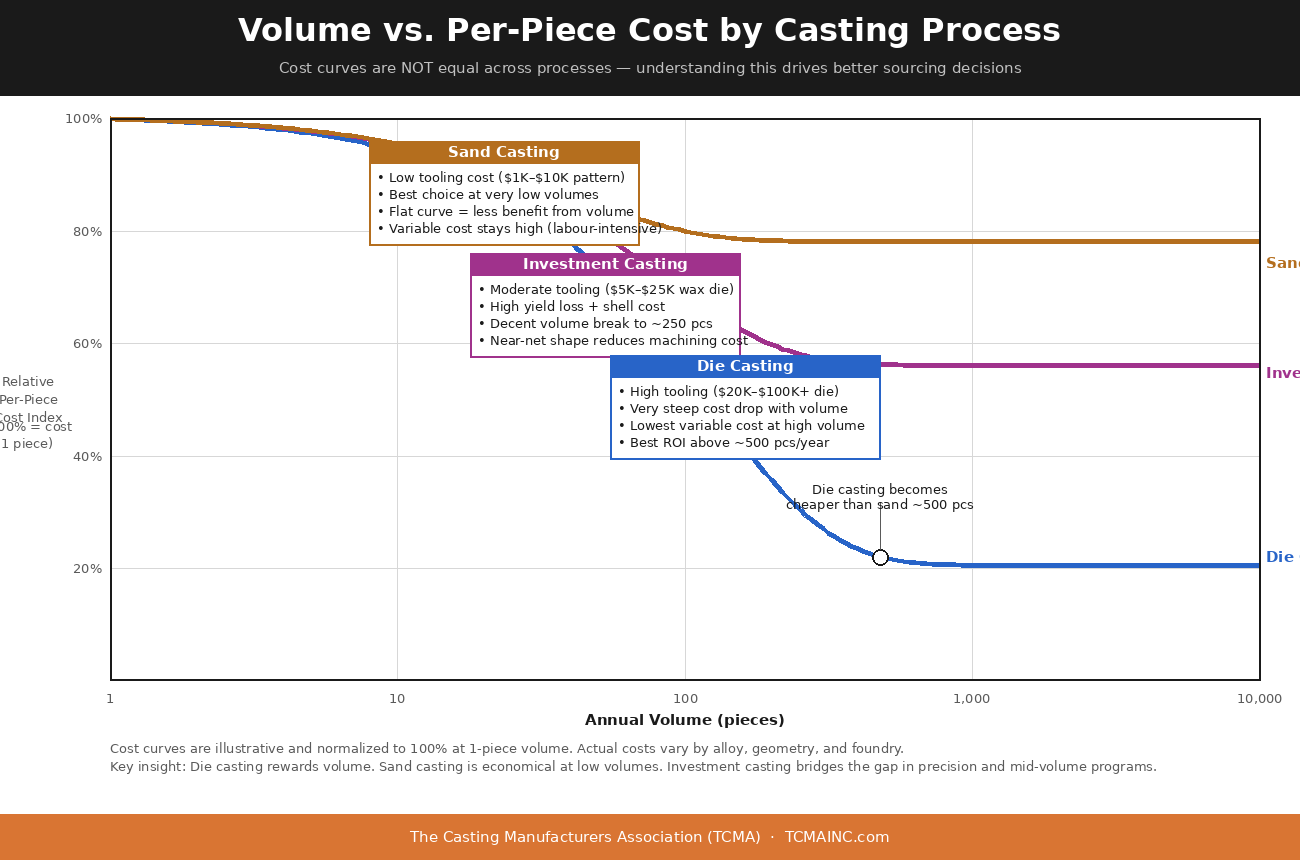
Casting economics change dramatically with volume. Understanding the cost structure at different volume tiers helps you make smarter sourcing and inventory decisions.
Fixed vs. variable cost in casting:
Every production run has fixed setup costs — furnace heat, mold preparation, machine setup, first-piece inspection — regardless of how many parts are made. These fixed costs amortize across the lot. A 10-piece run carries the full setup cost burden on 10 parts; a 1,000-piece run spreads it across 1,000 parts.
Volume break economics:
Most foundries offer volume breaks at meaningful quantity thresholds. A typical price ladder might look like:
What buyers get wrong:
What to ask your foundry:
"What are your volume break thresholds for this part? What would the per-piece price be at 2x my current annual volume? What's the minimum order quantity to avoid a small-lot surcharge?"
Negotiating tip: Ask for a blanket purchase order with scheduled releases. You commit to the annual volume (earning the volume price break) while managing inventory with smaller periodic releases.
Rush orders cost more — in every manufacturing process, and casting is no exception. But the premium for short lead time in casting is often larger than buyers expect, because the process has hard physical constraints that cannot simply be overridden by paying more.
Why casting lead times are longer than most machining:
Typical lead times by scenario:
What buyers get wrong:
What to ask your foundry:
"What is your standard lead time for reorders from existing tooling? What's your expedite lead time and what premium does it carry? Do you offer stocking or consignment programs for our regular production parts?"
Certifications and inspection requirements add real, measurable cost to casting programs. This is not an argument against requiring them — it's a framework for requiring the right ones and understanding what you're paying for.
Certification cost drivers:
Inspection frequency economics:
The most impactful inspection specification decision you make is frequency. The cost difference between "first article inspection only" and "100% dimensional inspection every lot" on a complex casting can be $5–$50 per part depending on part complexity. Match inspection frequency to actual risk:
PPAP and APQP cost:
Automotive customers often require full PPAP Level 3 submissions before a new casting is approved for production. PPAP documentation preparation takes 20–80 hours at a casting foundry. This cost is real and often quoted separately — or quietly buried in the piece price. Clarify PPAP requirements and associated NRE costs early.
What to ask your foundry:
"What's included in your standard inspection package? What would a first article inspection report cost separately? If I relax my inspection frequency on this commodity part, what's the per-piece price reduction?"
Payment terms are a pricing lever that most buyers overlook entirely — but foundries price them explicitly, even if they don't say so.
How payment terms affect cast pricing:
Foundries carry significant working capital in raw materials, WIP, and finished goods inventory. They also have fixed costs (labor, energy, equipment payments) that continue regardless of when customers pay. Every day a foundry waits for payment is a day of financing cost they must cover.
The cost of extended terms:
A foundry carrying $2M in receivables at Net 60 terms vs. Net 30 is effectively financing an additional $330,000 in working capital (assuming even distribution of AR). At a typical small business cost of capital, that's real money — and it gets priced into quotes.
Common term structures and their cost implications:
Negotiating tip: If your procurement policy mandates Net 60 or Net 90, consider whether the implicit price premium you're paying exceeds the value of the extended float. For strategic casting suppliers, early payment discounts (2/10 Net 30) are often the most efficient way to reduce total casting spend without renegotiating piece prices.
Engineering changes after tooling is built are one of the most significant and underestimated sources of casting program cost overrun. Understanding how ECO costs work helps you make better upfront design decisions — and negotiate more fairly when changes are necessary.
What drives ECO cost in casting:
The critical implication:
The further into tooling a design change occurs, the more expensive it is. A change to a casting drawing before tooling is cut costs nothing. The same change after die casting tooling is complete can cost $20,000–$80,000. This is why design freeze milestones and formal first article review before tooling release are worth the time they take.
What to ask your foundry:
"If we need to change [specific dimension or feature] after tooling is built, what's the likely cost range? Is that change additive (weld/add steel) or does it require a new insert?"
Design tip: For die casting tooling, build in conservative dimensions on features you're uncertain about — it's easier to remove material from a die (making a casting feature larger) than to add it (making a feature smaller).
The final pricing lever is the one that appears on the last line of the invoice but is calculated last: freight, packaging, and total landed cost.
Why it matters more than it seems:
Castings are heavy. A shipment of production castings can weigh hundreds or thousands of pounds. Freight cost is not trivial — it can represent 3–15% of total casting cost for domestic shipments and significantly more for international sourcing.
Packaging impact on total cost:
Hidden freight cost traps:
Total landed cost framework:
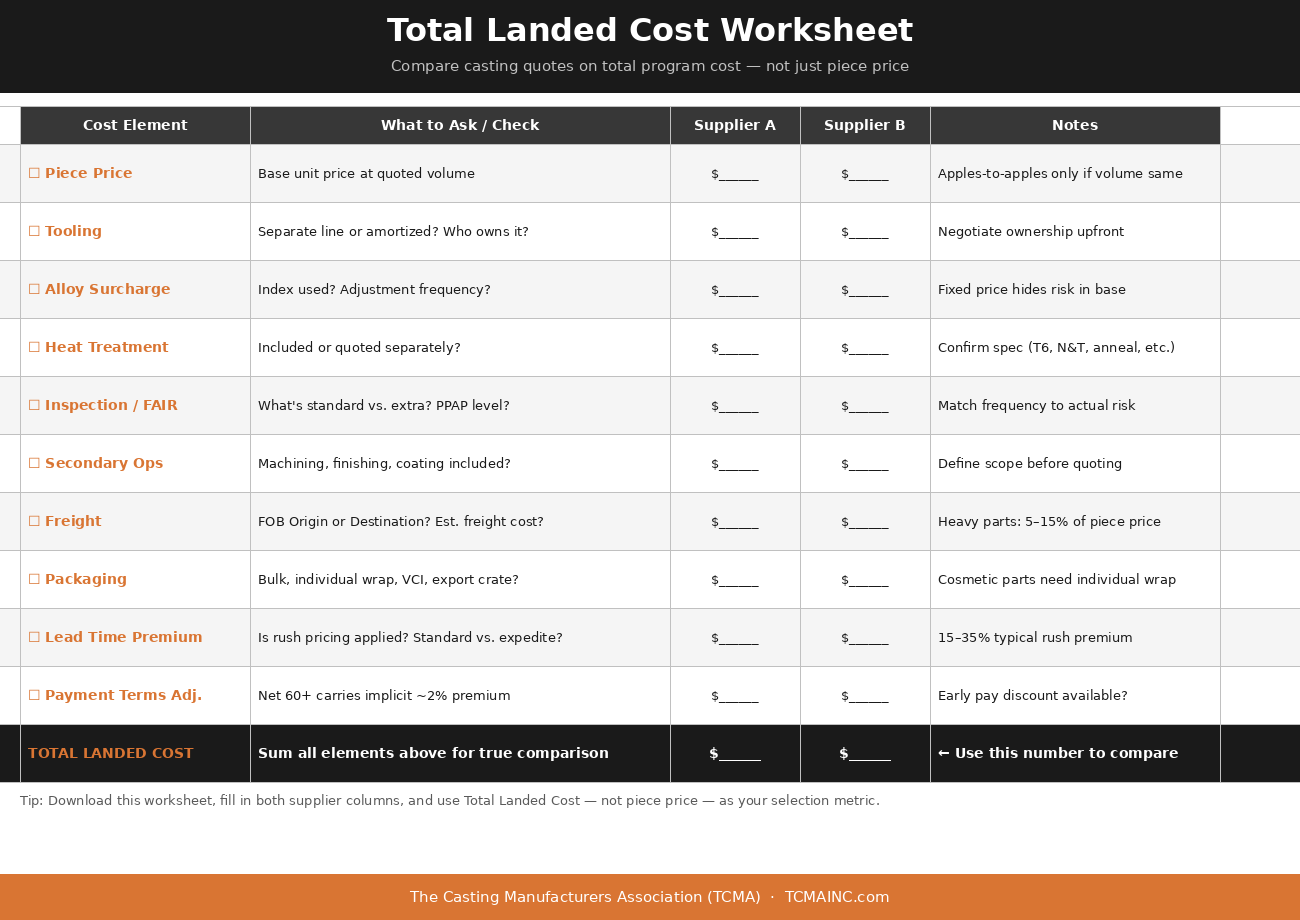
When comparing quotes from multiple foundries — especially when one is geographically distant — always calculate total landed cost: piece price + tooling amortization + freight + packaging + inspection + payment terms adjustment. The lowest piece price is rarely the lowest total cost.
What to ask your foundry:
"What are your standard shipping terms? Do you offer consolidated shipping for blanket orders? What packaging is included in your quote, and what would individual part protection add per piece?"
Before accepting or comparing casting quotes, run through this checklist to ensure you're comparing total cost — not just piece price:
☐ Tooling: Is tooling quoted separately or included in piece price? Who owns it?
☐ Alloy: Is there an alloy adjustment clause? What index and frequency?
☐ Yield: What's the typical yield for this part and process — and how does it affect alloy cost?
☐ Secondary ops: Is heat treatment included? What inspection is in the base price?
☐ Volume: Are you ordering at the most economical lot size? Are volume breaks available?
☐ Lead time: Is there a rush premium applied to this order?
☐ Certifications: Are certification costs (PPAP, FAIR, Nadcap audits) included or separate?
☐ Payment terms: Are extended terms carrying an implicit price premium?
☐ ECO risk: Have you design-frozen the part before releasing tooling?
☐ Freight: What are the shipping terms? What does total landed cost look like?
The ten levers in this guide aren't just buyer education — they're a communication framework for foundries. When a customer pushes back on your price, walking them through yield, tooling amortization, and alloy exposure in plain language converts a price negotiation into a cost transparency conversation. Buyers who understand why castings cost what they cost are easier to work with, more likely to give you the information you need to quote accurately, and more likely to stay when a competitor offers a lower number that doesn't account for the same factors.
Consider sharing this guide with your own customers as part of your quoting process. TCMA members are welcome to reference and link to this resource.
Understanding casting cost is step one. Finding a foundry that delivers competitive pricing, transparent quoting, and consistent quality is step two.
TCMA's directory connects buyers with verified casting manufacturers across North America. Submit your project and let us match you with foundries that fit your process, alloy, volume, and certification requirements.
Visit TCMAINC.com to browse verified casting manufacturers or submit a project.
Published by The Casting Manufacturers Association | TCMAINC.com | Supporting North American foundries and the buyers who rely on them